

Basseterre, St. Kitts, August 18th 2026 (PMO) – As persistent inflation, elevated prices and wider global economic uncertainty continue to place pressure on households across the Caribbean and beyond, the Government of St. Kitts and Nevis is maintaining a proactive approach to protecting families and strengthening their ability to withstand external economic shocks.
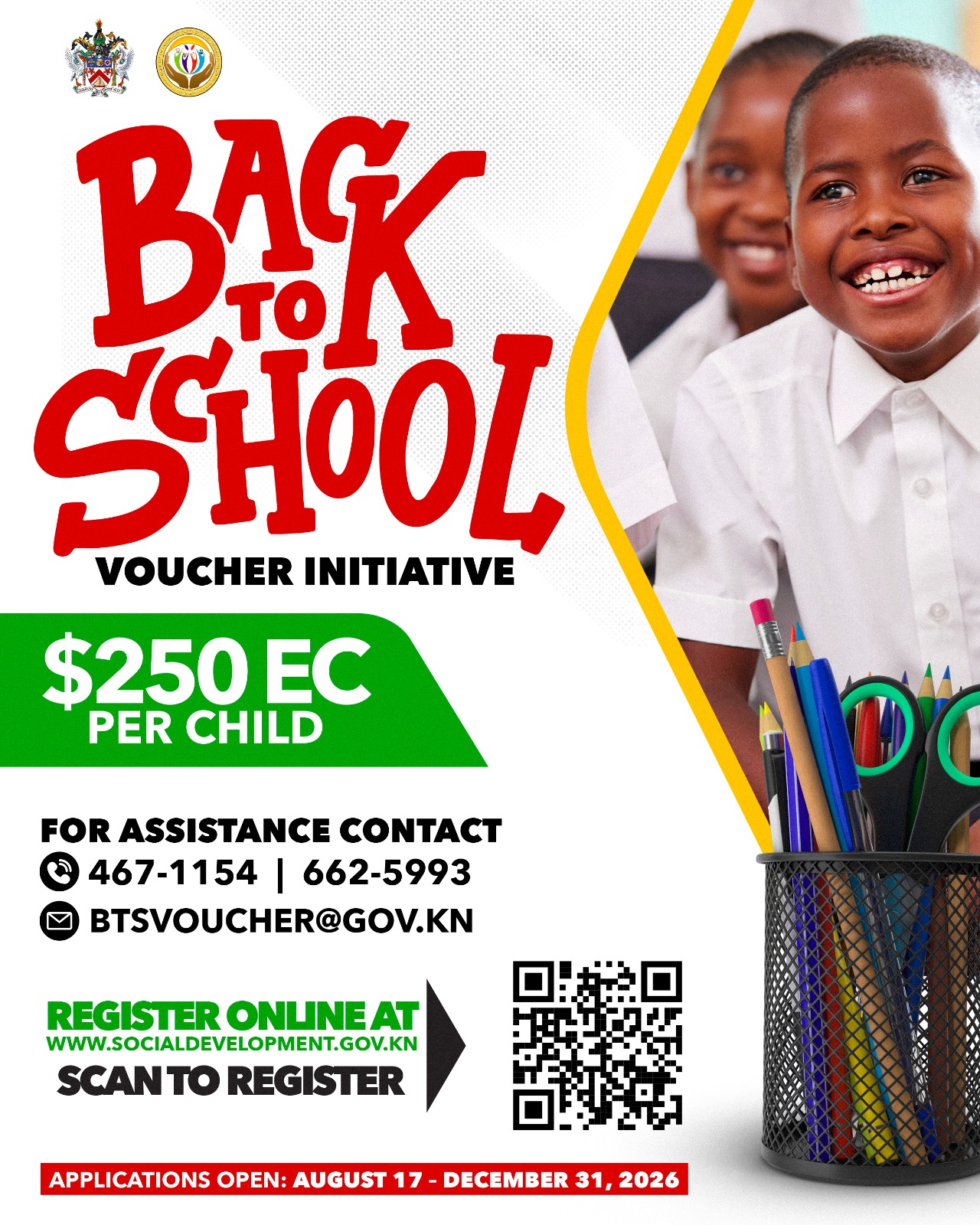
The recently launched 2026 Back-to-School Voucher Programme, which provides EC$250 for every eligible child, represents the latest in a series of targeted interventions by the Drew-led Administration aimed at reducing household expenses and placing additional financial resources directly into the hands of families.
The programme provides assistance to eligible children enrolled for the 2026–2027 academic year in licensed pre-schools, primary schools, secondary schools and tertiary institutions across the Federation. Applications opened on August 17 and will remain open through December 31, 2026.
For the Government, the programme is part of a wider philosophy that recognises that while St. Kitts and Nevis cannot control international inflation, geopolitical uncertainty, global supply-chain disruptions or other external forces that affect prices, it can take deliberate action at home to reduce the impact of those pressures on its people.
Prime Minister Hon. Dr. Terrance M. Drew has maintained that difficult international economic conditions cannot become an excuse for inaction.
“We cannot control everything that happens beyond our shores, but we can control how we respond. When international conditions place greater pressure on the pockets of our people, our responsibility as a Government is not to sit idly by and simply tell families that times are difficult. Our responsibility is to act, to find practical, responsible and meaningful ways to help our people weather the storm,” Prime Minister Drew said.
That approach has been reflected in a suite of measures implemented by the Government to strengthen household incomes, expand social protection and reduce costs.
Since assuming office, the Drew-led Administration has increased the national minimum wage to the highest among the independent OECS states, increased salaries for civil servants, introduced gratuity and pension benefits for Government Auxiliary Employees, strengthened health protection for public servants, established the Children’s Medical Fund and invested EC$1,000 for eligible children between the ages of five and eighteen through the ASPIRE programme.
The Government has pursued these social interventions while simultaneously working to improve the country’s fiscal position and significantly reduce the fiscal deficit, underscoring its position that responsible economic management and strong social support do not have to be competing objectives.
The 2026 Back-to-School Voucher Programme is also being implemented alongside Discounted VAT Rate Days on August 28 and 29, as well as duty-free concessions on eligible school supplies, which remain in effect through September 30. Together, the measures are designed to give parents greater purchasing power during one of the most financially demanding periods of the year.
Prime Minister Drew said the Government’s focus remains on ensuring that macroeconomic progress translates into tangible benefits in the daily lives of citizens.
“Economic management must ultimately be about people. It must mean something to the mother purchasing school uniforms, to the father trying to stretch his salary to cover books and groceries, to the pensioner meeting monthly expenses, and to the young person trying to build a future. That is why our response has been broad, deliberate and people-centred,” the Prime Minister stated.
The Government’s interventions reflect an understanding that cost-of-living pressures cannot be addressed through a single programme. Instead, the Administration has sought to respond on several fronts – -raising incomes, reducing certain taxes and duties, investing directly in children, strengthening social protection and introducing targeted relief at critical periods.
The Back-to-School Voucher Programme itself builds on a similar initiative introduced by the Drew-led Administration in 2023 and expands that commitment to direct assistance for families preparing their children for school.
Under the 2026 programme, the benefit is calculated per eligible child, meaning a household with more than one qualifying child can receive EC$250 for each. Approved benefits will be deposited directly into the main applicant’s existing JAD digital wallet following the necessary verification of the applicant, the child’s enrolment and the digital wallet.
The Government of St. Kitts and Nevis has reaffirmed that it will continue to monitor the economic environment and respond where necessary with policies that are fiscally responsible, targeted and capable of providing meaningful relief.
At the centre of that approach remains a simple commitment: that even as St. Kitts and Nevis navigates an uncertain international environment, its people should know that their Government is paying attention, planning ahead and taking action to help protect their quality of life.